Microsoft Power Platform
The platform for no-code, low-code, and pro-code solutions—integrated, scalable, and future-proof.
The platform for no-code, low-code, and pro-code solutions—integrated, scalable, and future-proof.
Connect and leverage various data sources. Build apps for tasks in hours instead of days. Set up automated workflows between your favorite apps and services.
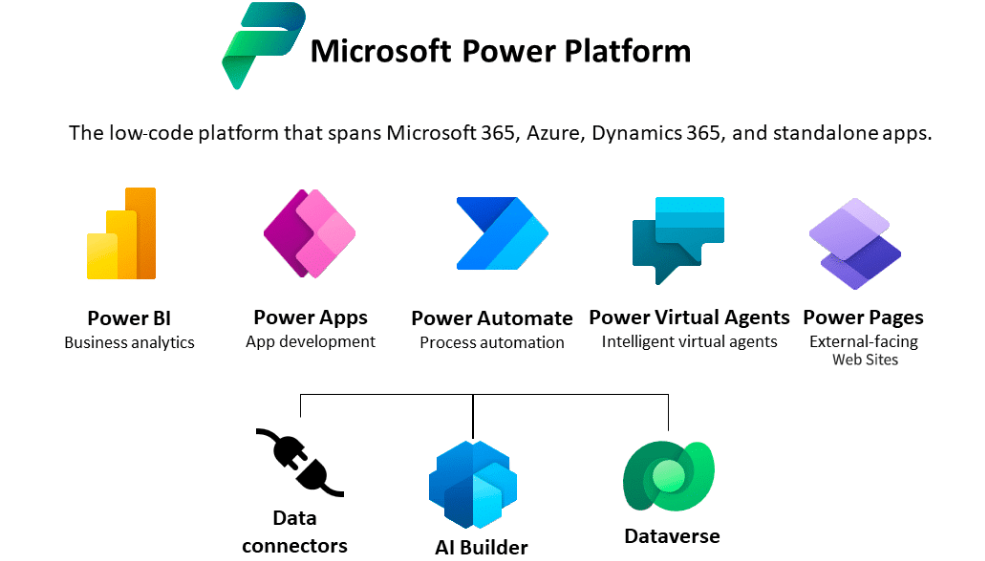
The Microsoft Power Platform is a central platform for digitizing business processes, app development, data utilization, and AI-powered interactions.
The Ambit Group views it as a strategic business platform that integrates no-code, low-code, and pro-code into a professional architecture, security, and operational framework.
Our focus is on scalable solutions—whether as extensions of CRM, ERP, and data platforms or as standalone components for business units and entire organizations.
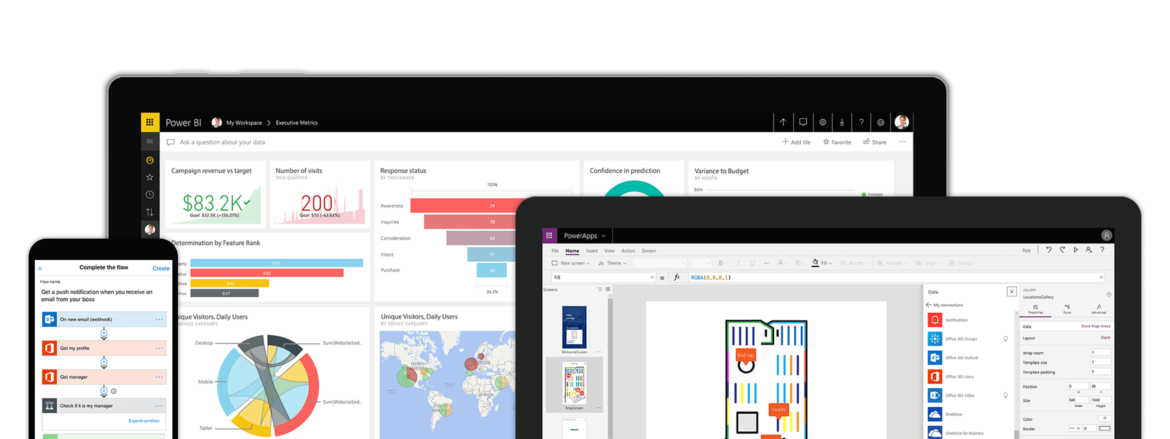
The strength of the Power Platform lies in the coordinated interaction of different development approaches.
Ambit deliberately positions itself in the low-code and pro-code domains and ensures that solutions:

Power Apps enable the development of business-oriented applications in areas where standard software reaches its limits. Ambit does not view Power Apps as a replacement for traditional development, but rather as a productive low-code layer that is specifically enhanced with pro-code.
We rely on a clean application and data model, extend solutions via custom APIs and Azure Functions, integrate CRM, ERP, and third-party systems via 1,000+ connectors, and ensure governance and lifecycle management.

For Ambit, Power Automate isn’t just a tool for simple workflows; it’s an orchestration layer for end-to-end processes that span system and organizational boundaries.
We analyze and prioritize processes based on business value, combine standard workflows with custom connectors and pro-code services, and ensure stable operations through exception handling, monitoring, and clear operational concepts.

Power BI is much more than just a reporting tool. When used correctly, it becomes a central management and analysis tool for business units and management.
We define KPIs and control logic, integrate Dataverse, ERP, and data platforms, establish a consistent reporting architecture, and support the transition to modern data platforms such as Microsoft Fabric.

Power Pages are used to build secure, integrated web applications and portals—for customers, partners, or members. Ambit uses Power Pages as an accelerated web framework, not as a simple website builder.
We design user journeys and portal layouts, deeply integrate CRM, ERP, and line-of-business applications, extend functionality as needed with custom code (APIs, JavaScript, custom services), and ensure robust security and operational models.

Copilot Studio provides an entry point into agent-based architectures. For Ambit, the focus isn’t on chatbots, but on AI-powered assistants that take over processes and ease the burden of day-to-day business operations.
We draw a clear distinction between humans, AI, and automation; integrate AI agents into existing processes; and ensure governance, security, and quality control.

Professional power platform solutions require a solid foundation. Dataverse, security concepts, and governance are crucial for making no-code, low-code, and pro-code solutions enterprise-ready.
We provide structured support to our clients from preparation through implementation to ongoing operations.
In doing so, we develop robust architecture and data models, define professional environment strategies (Dev / Test / Prod), establish governance and security concepts, and assist in building a sustainable Power Platform operating model, including a Center of Excellence.

Use Cases, Architecture, Target State, Business Value Proposition

Solution design, MVP, validation

Scaling, Governance, Integration

Operation, Optimization, Further Development

andri.fabig@!ambit-group.com
+41 52 268 91 22

